Young Talent Music Lab
Mission & Vision
Mission & Vision
Young Talent Music Lab believes that musical talent develops by playing together, performing often and being challenged at the right moment.
Our artistic mission and vision describes how YTML creates an environment in which young musicians can discover, develop and perform — alongside school, study and everyday life.
Our Mission & Vision
A sixteen-year-old boy has been playing saxophone for years. He is good, perhaps very good. Ask him what he wants to be later, though, and music isn’t his answer. He wants to go to university.
An eighteen-year-old girl has been playing drums for years and is now studying at vocational college. She isn’t really looking for more music lessons. She is looking for other young musicians who challenge her, a good band to play in and a stage where something is regularly expected of her.
Somewhere at a university or college, there is also a student who has played piano since the age of eight and has reached a considerable level. Almost nobody on their course knows it. We probably don’t either.
Young Talent Music Lab is meant for young people like them.
We don’t believe a young musician needs to know at fourteen or sixteen whether music will become their profession. You can finish school and still take trumpet seriously. You can study engineering, economics or medicine and continue playing in a good orchestra or ensemble.
The question is not so much when someone chooses music. The question is whether, in the meantime, there is an environment in which they can continue to develop musically.
That is what we want YTML to provide.
You Learn Music Mainly by Doing It
Good teachers matter. An experienced professional can sometimes hear in ten seconds what a young musician has been struggling with for weeks. Technique, ear training, theory and repertoire require people who know their craft — and those professionals should be properly paid.
But not every hour in which a young musician improves needs to be a paid lesson.
You also learn an enormous amount in a band, combo or orchestra. Because the person next to you plays better. Because you discover that the whole group notices when you haven’t prepared your part. Because a drummer pulls you along, or a conductor asks just a little more of you than you thought you could do.
And sometimes because you play a solo at a concert that goes completely wrong — and a week later, you get another chance.
We think that matters just as much.
There has to be playing.
A Playing Field for Music
he idea behind YTML is, in that respect, more like a Johan Cruijff Court than a traditional school.
On a Cruijff Court, there isn’t a trainer with a lesson plan supervising every game. First of all, there is a good playing field — and there are other players. One is twelve, another seventeen, and the best player naturally becomes someone others watch and learn from.
They play, observe, try things and play again. A good coach remains important, especially when someone has more potential and wants to go further, but the game comes first.
That is the kind of playing field we want to create for music.
A place you want to go because other musicians are there. Where one ensemble is rehearsing while a band is playing somewhere else. Where someone stays a little longer after their own rehearsal. Where a talented nineteen-year-old trumpet player can be just as inspiring to a fourteen-year-old as the professional who comes in to give a masterclass.
There Is Actually Nothing New About This
Anyone familiar with the world of wind bands, fanfares and brass bands will recognise much of this idea.
A local music association had a rehearsal space, instruments, a youth orchestra and a main orchestra. Younger musicians played alongside older ones. There was a conductor, there were concerts, and parents came to watch or help out. As you improved, you moved forward and there was always something new to look forward to.
That worked for generations. YTML doesn’t need to reinvent it.
Rotterdam simply requires a different form. Young people move through a much larger city and between school, vocational education, university, sport, work and different cultural worlds. They play jazz, pop, classical music, funk, soul, hip-hop — or a mixture of everything.
What we do want to carry forward from that tradition is very practical: a place where you belong, access to an instrument, lots of playing together, older musicians taking younger ones along, parents becoming involved, and always a next step to work towards.
It may look different today. But the principle is remarkably familiar.
Circle of Talent
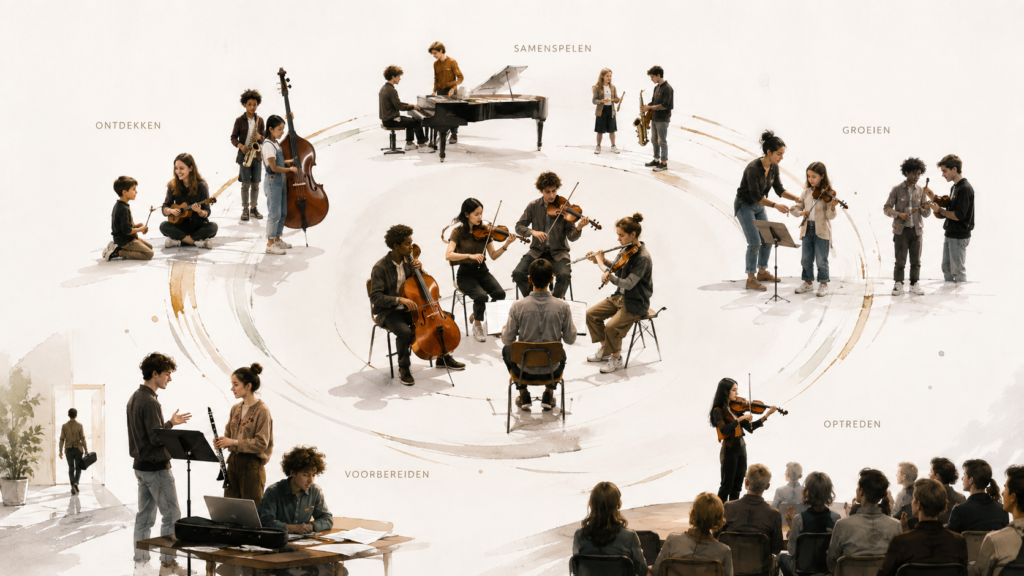
From the beginning, we have talked about a Circle of Talent at YTML.
It is not a ladder that everyone has to climb as quickly as possible. We want young musicians of different ages and levels to meet and play together.
A strong seventeen-year-old can be a great example for a fourteen-year-old. A conservatoire student may share something during a rehearsal that helps a younger musician for weeks. And someone of twenty also learns by taking responsibility for someone who is less experienced.
You are not simply a student for years until one day you suddenly have something to offer. Those roles overlap.
In musical practice, that happens naturally once you bring the right people together.
Ambition Matters Too
Accessibility does not mean that everything has to be easy.
Some young musicians simply want to make music with others. Others want more. They want to play more difficult repertoire, perform more often, prepare for an audition or find out whether a conservatoire might be right for them.
There should be room for both.
That is why YTML needs different levels and different ensembles. Not everyone has to end up in the Young Talent Jazz Band. But someone who has the talent and ambition should be able to see a route towards it.
And someone who does not want to become a professional musician should still be able to keep developing at a high musical level.
Ambition is welcome. It just does not have to lead to the same destination for everyone.
Music and Education Can Run Side by Side
YTML is an extracurricular programme. It is designed to complement school or study, not replace it. Completing school and continuing education remain important, also for young musicians with exceptional talent.We do not see school and musical development as competing routes.
A young musician can attend secondary school, vocational college or university and continue to develop musically at the same time. For many young people, those two paths can run alongside each other for years.
Only later, for some, a third possibility may emerge: a conservatoire or professional musical practice.
That is a possibility, not an obligation.
Someone can complete a university degree and continue playing music at a high level for the rest of their life. That is not a failed musical journey. It is a valuable outcome in its own right.
YTML therefore does not ask young musicians to choose between education and music. We want to create an environment in which both can continue to grow.
Playing Often Changes Everything
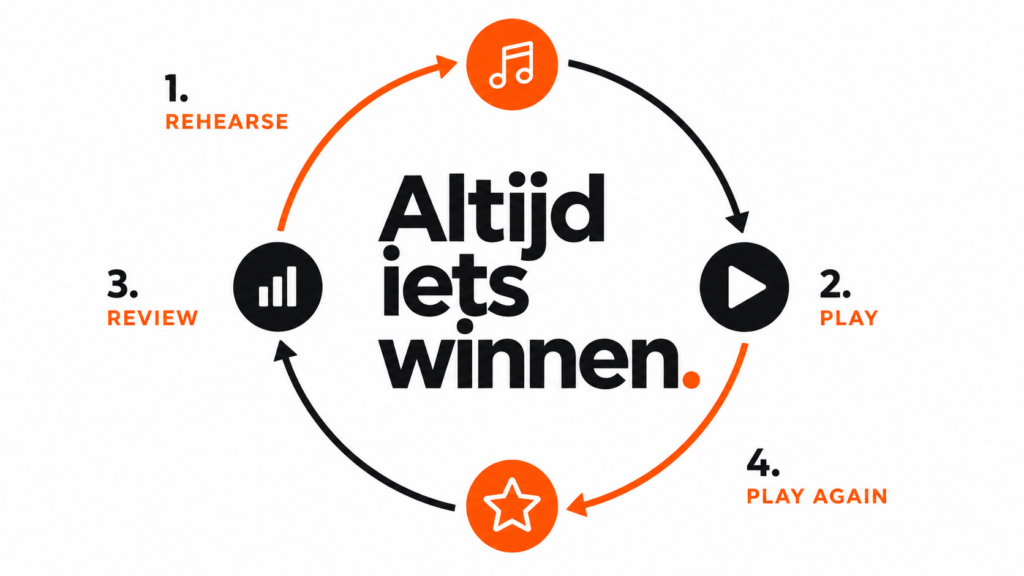
Young musicians need opportunities to play. Not once at the end of a course, but again and again.
Rehearse. Perform. Look back. Try again.
Not every performance will be perfect. That is precisely the point. A missed entrance, nerves on stage or a solo that does not quite work is not simply a failure. The experience goes with you into the next rehearsal and the next performance.
There is always something to gain.
The more often young musicians experience that cycle, the more natural performing becomes — and the more responsibility they begin to take for their own development.
Parents Should Be Close, but Not at the Wheel
Parents make a great deal possible. They drive, pay, encourage, wait, organise and sometimes worry.
We want them to be involved.
Come and listen to a rehearsal. Attend a concert. Meet the coaches and other parents. See your child play alongside other young musicians — and come back six months later.
Musical development should be something you can see and hear.
At the same time, the musical ambition must remain with the young musician. A parent can encourage, make things possible and sometimes give a necessary push, but ultimately the young musician has to want to play, practise and take the next step.
Parents should be close to the journey, but they should not have to drive the musical ambition.
Access to Music Should Not Depend on Owning an Instrument
A good saxophone, trumpet, double bass, keyboard or other instrument costs money. That simple reality can quickly become a barrier.
That is why access to instruments is part of the YTML idea. Instruments may be available through loan or rental, through instruments donated to YTML and, where circumstances require it, by finding other ways to make an instrument accessible.
The same applies to participation. Good rehearsal spaces, conductors, teachers, coaches, equipment and maintenance all cost money. We believe professionals should be paid properly and that Fair Pay matters.
The real question is therefore not how to pretend those costs do not exist, but how we can share them fairly.
We want YTML to remain accessible while building a sustainable organisation with a mix of participation fees, earned income and support from businesses, donors, funds and public partners.
A Home Base for Young Musicians
A permanent home for YTML is more than a roof over our heads.
Of course there need to be good rehearsal spaces. But what happens between those spaces may be just as important.
A young musician arrives for a rehearsal and hears something interesting happening next door. A band stays a little longer. Parents have coffee while they wait. A professional musician drops in. A few players decide to try something together the following week. In the evening, there may be a jam session or a concert.
Not everything needs to be programmed in advance.
Over time, such a place becomes more than a building with rehearsal rooms. People know where to go. They know each other. They feel at home and begin to take responsibility for the place themselves.
That is the musical home and creative breeding ground we want Young Talent Music Lab to become.
Always a Home Game
We want young musicians to perform often — much more often than at a single polished presentation after months of rehearsing.
Knowing that you will be on stage next week changes the way you rehearse. You learn to deal with nerves, an audience and the responsibility of being prepared.
We like to think of these performances as home games.
A home game takes place somewhere familiar, surrounded by people you know. Parents and friends can come and listen. You have played there before — and you know there will be another opportunity soon.
Not everything has to go perfectly. You may miss an entrance, play a wrong note or completely mess up a solo.
But you played. And soon, you get another chance.
That is why there is always something to win: experience, courage, enjoyment, stage confidence — or simply the feeling that you want to do it again.
And Above All: Let Them Play
YTML is not intended to replace the music association, the music teacher, the school or the conservatoire. We need all of those worlds.
We want to add a place where young musicians can continue to develop between and alongside them. A place where someone can finish school or university while continuing to make music seriously. A place where you can simply come and play — but where there is also a challenging route for those who want more.
In the end, it is not that complicated.
Create a good place. Bring in good people. Make instruments accessible. Bring young musicians together who can learn from one another. Let parents see what is happening. Raise the bar when someone is ready for it.
And above all: let them play.
The next home game should never be far away.